

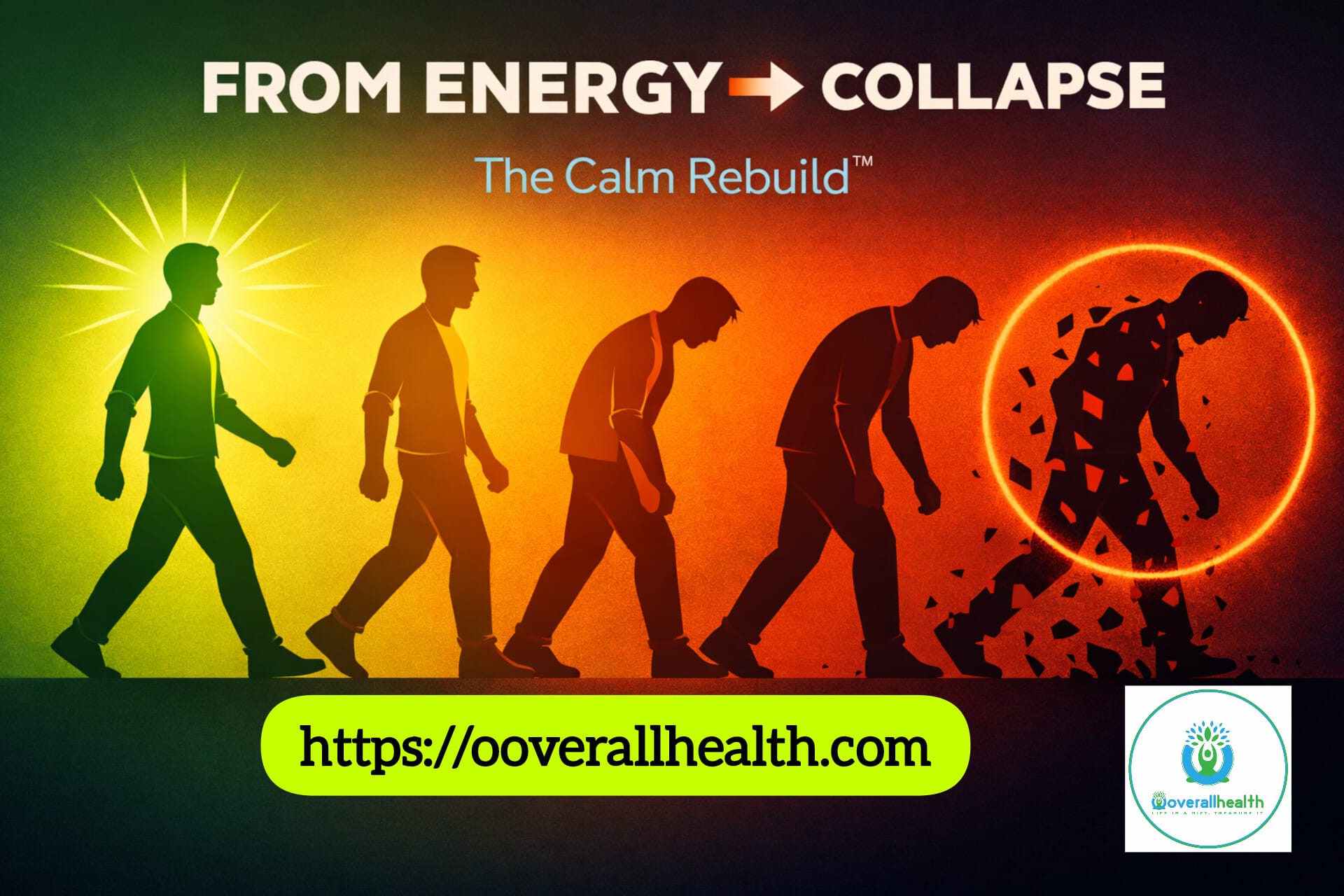
The Signs of High-Functioning Burnout
The high-functioning burnout blind spot
High-functioning burnout rarely looks like a breakdown.
It looks like you still showing up.
You’re still delivering. Still replying quickly. Still taking meetings. Still being the reliable one. From the outside, nothing is “wrong.”
But inside your body, something has changed.
You wake up tired and stay tense all day. You can’t fully relax even when you have a free evening. Your mind keeps scanning for what’s next. Your patience gets thinner. Your empathy is less accessible. You’re using caffeine to start the day and some kind of numbing to end it. Sleep doesn’t restore you the way it used to. These are common patterns under chronic stress, and chronic stress is well established to disrupt sleep, mood, cognition, and physical health over time.
If you’ve been telling yourself “I’m just stressed,” but the symptoms keep stacking, you may be dealing with burnout symptoms while still functioning at a high level.
That’s the paradox.
High performers often don’t notice burnout early because they’re trained to interpret strain as normal, ignore body cues, and solve problems with effort. Burnout, by definition, develops when chronic workplace stress has not been successfully managed—so pushing harder is often the exact thing that deepens it.
This article walks you through seven high-functioning burnout signs—what they look like, what’s happening underneath (body + nervous system), and what to do next with a plan that is realistic for high-stakes professionals.
What burnout is and what it isn’t
Burnout is not a vague internet trend. It has a widely recognized occupational definition.
The World Health Organization describes burnout in ICD-11 as a syndrome resulting from chronic workplace stress that has not been successfully managed, characterized by three dimensions: exhaustion, mental distance/cynicism, and reduced professional efficacy.
That matters because high-functioning burnout often hides in plain sight: you may still be “effective” on paper while exhaustion and detachment are quietly advancing.
Burnout is also not identical to depression, although they can resemble each other and sometimes co-occur. Mayo Clinic notes burnout isn’t a medical diagnosis and that symptoms can overlap with other conditions, including depression, and may require different treatments.
A Canadian lens is also helpful. The Canadian Psychological Association emphasizes that “burnout” is used in different ways across sources, which adds confusion, and points back to the three-dimensional framing (exhaustion, cynicism, inefficacy) when describing workplace burnout.
So here’s the cleanest way to hold it:
Stress is often pressure with a sense of urgency—you can still care, still engage, and still feel meaning, even if you’re overloaded.
Burnout is often pressure without recovery long enough that the system starts to shut down—emotionally, cognitively, motivationally.
High-functioning burnout sits between those two: you’re still operating, but your body is paying an increasingly steep cost.
Why high-performing nervous systems get stuck in dysregulation
If you want to spot high-functioning burnout, you have to stop thinking only psychologically and start thinking physiologically.
Your body has a stress-response system designed to mobilize you for challenge. It’s not “bad.” It’s protective.
The issue is what happens when mobilization becomes your baseline.
The body’s stress system is meant to turn off
Chronic stress effects are not subtle. The American Psychological Association notes that chronic stress can contribute to long-term problems across multiple systems in the body.
Mayo Clinic similarly explains that long-term activation of the stress response system and prolonged exposure to stress hormones can disrupt many body processes and increase risk of problems, including anxiety, depression, digestive issues, headaches, muscle tension, sleep problems, and memory/focus issues.
So yes, burnout symptoms can show up as mental, emotional, and physical signs at the same time.
Nervous system dysregulation: the “stuck” feeling isn’t you being weak
When people say “nervous system dysregulation,” they’re often describing a real-life pattern: difficulty shifting out of activation.
Your autonomic nervous system helps regulate involuntary functions like heart rate, blood pressure, breathing, and digestion.
When your sympathetic system (your “fight-or-flight” mobilization mode) stays active too easily or too long, you can enter a hyperarousal state. Cleveland Clinic describes hyperarousal as a prolonged fight-or-flight response that’s activated too easily or stays active too long, with symptoms that can include hypervigilance, startling easily, sensory sensitivity, and angry outbursts.
This is one reason high performers can feel “tired but wired.” Your energy is depleted, but your threat system isn’t standing down.
Allostatic load: the hidden burn rate of high performance
A powerful research framework here is allostatic load—the cumulative “wear and tear” on the body when stress systems are repeatedly activated and do not resolve cleanly. Research reviews describe allostatic load as strain and wear-and-tear produced by systems under chronic challenge, closely associated with the work of Bruce McEwen and colleagues.
High-stakes professionals are especially vulnerable because the stressors aren’t episodic.
They’re continuous: constant connectivity, endless decision-making, and performance expectations that quietly train the nervous system to associate rest with danger (“If I rest, I fall behind”).
That’s how high-functioning burnout forms: not from one bad week, but from a long season of adaptation.

The signs of high-functioning burnout
High-functioning burnout isn’t an official diagnosis. It’s a useful description of a very common pattern: you’re still performing, but your system is deteriorating underneath.
Below are seven signs. You don’t need all of them for this to be real. The point is to recognize the pattern early—before your body forces a shutdown.
Exhaustion that sleep doesn’t fix
This is the most classic burnout symptom, and it’s often the earliest sign.
The WHO’s burnout definition starts with exhaustion—feelings of energy depletion.
Burnout researcher Christina Maslach has described exhaustion as a central dimension of burnout and notes it often correlates with stress-related symptoms such as headaches, chronic fatigue, gastrointestinal issues, muscle tension, and hypertension in research observations.
What it looks like in high performers:
You can still “push,” but the cost is rising. Tasks that used to take 30 minutes take 60. You need more recovery time, but recovery doesn’t refill you. You’re becoming efficient at functioning on depleted fuel.
Mini self-check:
If you took a low-demand week, would your energy actually return—or would you just feel a little less panicked?
Sleep gets lighter, more fragmented, or more “wired.”
High-functioning burnout commonly shows up as sleep disruption: trouble falling asleep, waking up at 3 a.m., waking early, or sleeping but not feeling restored.
The relationship between burnout and sleep problems is consistently observed in the literature, including studies showing associations between sleep disturbance and burnout in high-stress healthcare environments.
Stress physiology also directly undermines sleep; chronic stress is linked with sleep problems in clinical descriptions of long-term stress effects.
What it looks like in high performers:
You’re exhausted all day, then your brain turns on at night. Or you sleep but wake unrefreshed, with simmering anxiety already present.
What’s often happening underneath:
Hyperarousal is a key concept in modern insomnia models; reviews describe insomnia as involving increased physiological and cognitive-emotional arousal.
This is not just “bad sleep hygiene.” It’s a nervous system that won’t downshift.
Your brain feels slower: focus, memory, and decision fatigue
This sign scares high performers, because it hits identity: “I’m sharp. I’m reliable. I’m the one who remembers everything.”
Burnout can be associated with cognitive impairments. A systematic review and meta-analysis reported that clinical burnout is associated with small-to-moderate impairments across multiple domains, including executive function, attention/processing speed, and memory.
Other research reviews describe cognitive deficits (and frequent co-occurrence with anxiety and depression symptoms) in burnout contexts.
What it looks like in high performers:
You reread the same email three times. You can’t hold as many variables in your head. You procrastinate not because you’re lazy, but because starting feels cognitively expensive. You make uncharacteristic mistakes, then overcorrect by working longer.
Why it’s a big deal:
When cognitive capacity drops, high performers often respond by adding more control, more lists, more tracking, more working hours. That increases load and accelerates burnout.
Your emotional tone changes: irritability, numbness, or cynicism

This is the sign people rationalize the most: “I’m just tired,” “Everyone is annoying,” “My job has always been like this.”
But emotional shifts are central to how burnout is defined.
The WHO includes increased mental distance, negativism, or cynicism as a core dimension.
The Canadian Centre for Occupational Health and Safety notes burnout is frequently described with exhaustion, negativity/cynicism, and ineffectiveness, and provides examples like becoming less empathetic, detached, irritable, or impatient, along with reduced satisfaction and withdrawal.
What it looks like in high performers:
You’re less patient with coworkers, clients, or family. You feel emotionally flat. You no longer care about outcomes you used to care about, yet you keep performing because you don’t see another option.
Important nuance:
Cynicism can be a protective adaptation. When the body is depleted, emotional detachment reduces demand. It’s your system conserving energy.
You’re still producing, but you feel less effective inside
High-functioning burnout often hides behind metrics: you’re still meeting deadlines, still getting praised, still being relied on.
But internally, you feel less effective, less capable, and less satisfied.
The WHO includes reduced professional efficacy as a defining dimension of burnout.
Mayo Clinic lists questions that reflect burnout symptoms, such as feeling removed from work, lacking energy to do your job well, difficulty focusing, and feeling little satisfaction from what you complete, along with sleep changes and physical complaints.
What it looks like in high performers:
You keep output high by working around your fatigue: longer hours, less margin, more last-minute effort. Over time, the gap widens between your visible performance and your internal capacity.
This is where people crash.
Not because they suddenly lose ambition, but because the compensation strategy stops working.
Your body starts sending “background alarms.”
Burnout isn’t only in your head. It shows up in the body.
Chronic stress can contribute to health concerns like headaches, muscle tension, digestive problems, sleep problems, and memory issues.
In burnout research discussions, exhaustion is often linked with physical symptoms—headaches, chronic fatigue, gastrointestinal issues, and muscle tension, among them.
The Canadian occupational health guidance also lists physical complaints like headaches and backaches among common burnout effects, and explicitly advises checking with a health professional because similar symptoms can come from other conditions.
What it looks like in high performers:
Persistent tight shoulders and jaw clenching. Frequent headaches. Gut irregularity. A sense of being “keyed up” physically. Getting sick more often or taking longer to bounce back.
Why does this happen?
When your stress response stays activated, the body shifts resources away from long-term repair functions. Over time, that creates systemic strain—wear and tear consistent with allostatic load frameworks.
Your coping habits shift toward “numbing” and quick relief
This one is uncomfortable because it’s easy to normalize.
You call it “winding down,” “taking the edge off,” “just getting through the week.”
But when coping becomes compulsive, it’s often a sign your nervous system is struggling.
Canadian occupational guidance on burnout includes “feeling the need to use food, drugs, or alcohol to feel better or to simply not feel” as a possible effect, alongside sleep and appetite changes.
Research literature also supports links between workplace stressors and elevated alcohol consumption/problem drinking, underscoring that alcohol can be used as a coping pathway for some individuals under work stress.
Stress can also influence eating behaviours and cravings; reviews and studies describe relationships between chronic stress, cortisol, and food cravings or comfort-food patterns, though responses vary by individual.
What it looks like in high performers:
More caffeine to perform. More screens at night to shut the mind off. More sugar. More alcohol, “because otherwise I won’t sleep.” None of this makes you a bad person. It makes you a person whose system is trying to downshift the only way it currently knows how.
Critical pivot:
If your nervous system can’t settle without a substance or compulsion, you don’t need more discipline. You need a regulatory capacity.
How to recover from burnout without quitting your life
If you’re a high-functioning adult, your recovery plan must respect two truths:
You have real obligations.
Your nervous system does not negotiate with your calendar.
The goal is not to become someone who never feels stress. The goal is to restore regulation, capacity, and margin so your body can activate and then return to baseline.
Below is a step-by-step approach grounded in what burnout research models and stress physiology already emphasize: reduce chronic stress inputs, restore recovery, and address the work-context mismatches driving the syndrome.
Start with a two-week “capacity audit.”
High performers often wait for a crisis because they don’t trust subtle symptoms.
So make it measurable for 14 days:
Track three things (quick notes, not a complex system):
- Energy: Morning/afternoon/evening (0–10).
- Sleep quality: Restorative vs not.
- Arousal: “Calm baseline” vs “wired baseline.”
Why this matters: it reveals whether you’re dealing with a temporary stress spike or a chronic pattern consistent with burnout symptoms and nervous system dysregulation.
Reduce demand using a research-backed workplace lens
If you only add self-care on top of an unsustainable workload, you’re not recovering. You’re compensating.
Two major burnout frameworks make this plain:
The Job Demands–Resources model, originally developed by Evangelia Demerouti and colleagues, suggests job demands are primarily related to the exhaustion component of burnout, while lack of resources is primarily related to disengagement.
The “areas of worklife” model (workload, control, reward, community, fairness, values), associated with Maslach and colleagues, describes chronic mismatch between people and their work setting as a pathway into burnout.
So your next step is not “be more resilient.” It’s:
Pick one demand to reduce and one resource to increase—this week.
Examples that high-stakes professionals can actually do:
- Reduce one recurring obligation (one meeting, one standing commitment, one volunteer role) for 4–6 weeks.
- Add control: protect two daily focus blocks with no meetings.
- Increase resources: get staffing support, delegate, or renegotiate deliverables.
- Repair values mismatch: identify one part of your work you can do in a way that aligns more with what matters to you.
If burnout is being fuelled by chronic mismatch, these levers matter as much as breathing exercises.
Stabilize the nervous system with “micro-regulation,” not long rituals
High performers often reject regulation because they imagine it requires long meditation or a two-hour morning routine.
But nervous system regulation is about frequent, small state shifts, especially when your baseline is elevated.
Because the autonomic nervous system influences heart rate, blood pressure, breathing, digestion, and more, short practices that shift breathing and posture can support downshifting.
A realistic micro-regulation set:
- Two minutes of slow breathing after high-stress transitions (meeting → next task, work → home).
- A five-minute walk immediately after the most demanding part of your day (signals “stress cycle completion” for many people).
- A hard stop “shutdown cue” (same short routine each evening: dim lights, wash face, simple stretch, phone away).
This isn’t about perfect calm. It’s about training your body back into flexibility.
Treat sleep like a core pillar, not an optional add-on
Sleep is not just a symptom area. It’s a recovery system.
If you’re waking at night, feeling wired, or sleeping but not restored, consider evidence-based insomnia treatment.
The American College of Physicians recommends cognitive behavioural therapy for insomnia (CBT‑I) as the initial treatment for chronic insomnia disorder in adults.
CBT‑I guidelines and primers include specific behavioural instructions such as getting out of bed if unable to sleep within about 15–20 minutes, returning only when sleepy, keeping a consistent wake time, and discouraging naps, because these behaviours retrain the bed-brain association and consolidate sleep.
If your burnout symptoms include sleep fragmentation, this is one of the highest-leverage interventions you can pursue, because it reduces arousal and restores recovery capacity at the same time.
Get support sooner than your pride wants to
Occupational burnout guidance in Canada explicitly notes that burnout-like effects can overlap with other conditions (including depression and thyroid problems) and encourages checking with a health professional for appropriate evaluation and treatment.
If you’re experiencing severe mood symptoms, panic, escalating substance use, or inability to function, treat it as a health issue, not a productivity issue.
The mistakes that keep high performers stuck
High performers don’t fail to recover because they don’t care. They fail because they apply the wrong strategy to the wrong mechanism.
Mistake: Taking time off without changing the inputs
If you return to the same workload, the same expectations, and the same boundaries, your nervous system returns to the same stress pattern.
Burnout is defined as chronic workplace stress not successfully managed, so management must include changes in the work context, not only rest.
Mistake: Treating burnout like a motivation problem
When cognition is impaired and exhaustion is chronic, adding more effort often worsens the strain.
Burnout research and cognitive meta-analyses emphasize that cognitive capacity can be affected, so “push harder” can be biologically expensive.
Mistake: Over-relying on numbing tools to downshift
If alcohol, food, screens, or other quick-relief behaviours become the only off-switch, it’s a sign you’re missing regulation capacity.
Work stress, alcohol connections and occupational health guidance all highlight that some people use substances as coping pathways under stress and burnout patterns.
The goal isn’t shame. The goal is building a nervous system that can settle without requiring escape.
The deeper rebuild for high-functioning burnout
If you recognized yourself in several of these signs, here’s the truth:
You probably don’t need more information.
You need a structured process that restores baseline safety in the body and changes the pattern that keeps recreating burnout symptoms.
That’s exactly how The Calm Rebuild™ is framed on the OOverall Health program page: a 12-week live clinical-style experience aimed at high-capacity professionals, presented as a protocol rather than a generic course.
It’s described as a four-phase nervous system calibration journey that integrates somatic regulation, cognitive rewiring, and identity/boundary reconstruction, specifically for professionals who have tried surface solutions and still feel wired, restless, or depleted.
What’s especially relevant for high-functioning burnout is that the program is positioned around the mechanisms this article has highlighted:
- Stabilizing the baseline (nervous system calibration).
- Addressing perfectionism and overthinking patterns that maintain overdrive.
- Rebuilding cognitive capacity and tolerance under pressure.
- Creating systems and boundaries that prevent future collapse.
If your current “recovery plan” is just hoping the next weekend fixes the accumulation of chronic stress effects, a structured rebuild like this is the more realistic option, because it targets both physiology and the life architecture that keeps dysregulation alive.
Ready for a Biological Audit? Assess your Executive Physiological Baseline™ here: https://l.bttr.to/VicU9
Conclusion
High-functioning burnout is not a contradiction. It’s a stage.
It’s what happens when you can still perform, but your body is losing the ability to recover.
The WHO’s model makes burnout clear: exhaustion, cynicism/mental distance, and reduced professional efficacy are not personality issues; they’re a pattern of chronic, unmanaged workplace stress.
If you recognize these signs, don’t wait to “earn” rest by collapsing.
Treat the symptoms as data:
- Reduce the inputs that are driving chronic stress effects.
- Rebuild nervous system flexibility (so you can downshift, not just endure).
- Restore sleep with evidence-based methods when needed.
- Address work-demand mismatch using proven frameworks, not guilt.
And if you’re ready to stop “coping” and start rebuilding, The Calm Rebuild™ is designed for exactly that transition, from high-functioning survival mode to a stable baseline that can handle pressure without breaking.