Why Your Body Won’t Let You Relax
The calm you can’t access
You finally sit down. The day is “over.” There’s nothing urgent in front of you.
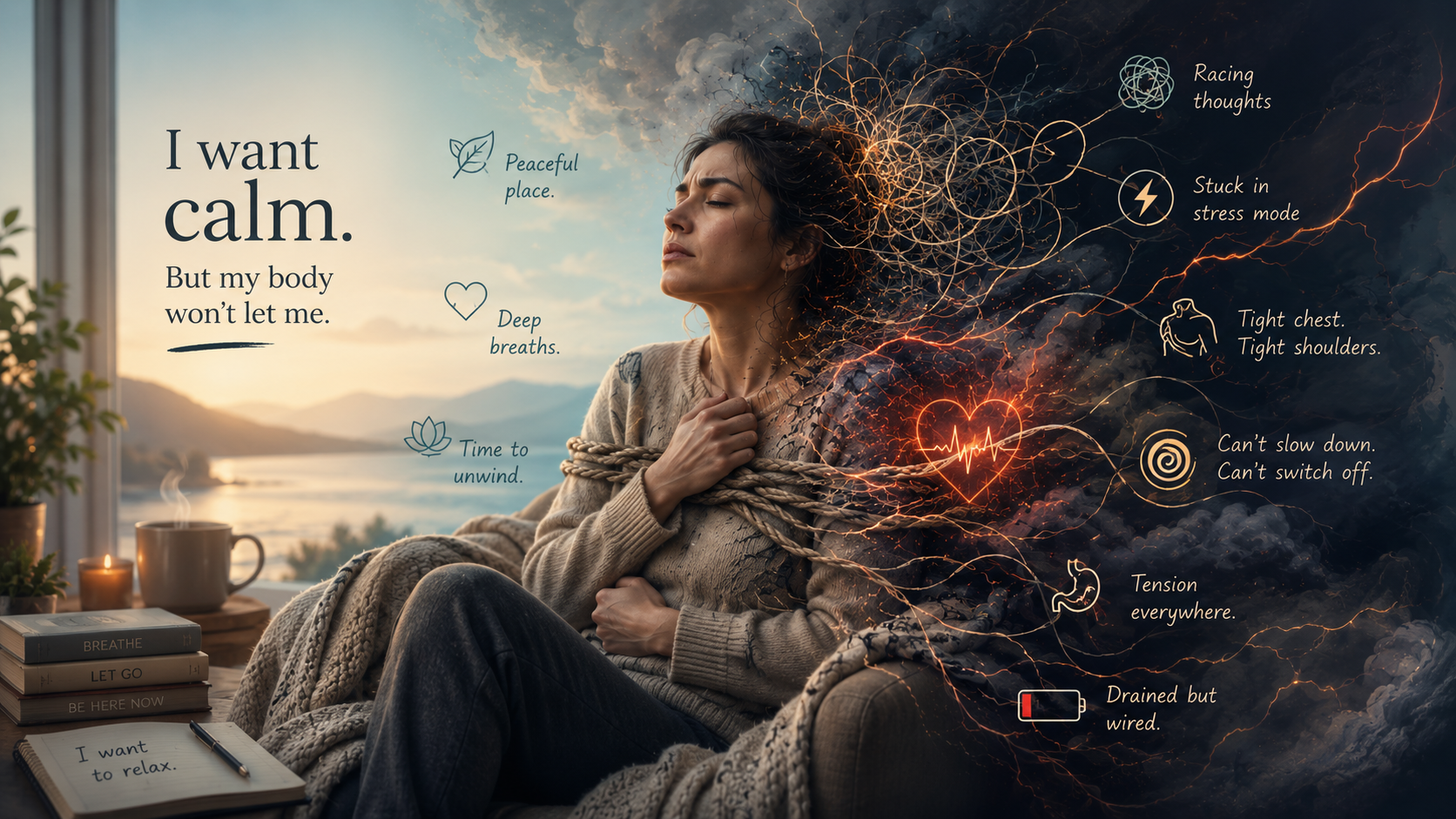
And still—your body won’t let you relax.
Your shoulders stay tight. Your jaw stays clenched. Your chest holds a faint hum of urgency, like you forgot something important. You try to watch a show, but your mind keeps looping. You try to lie down, but you feel restless and wired. Sometimes you want rest so badly it turns into pressure, and pressure makes it worse.
If you’re a high-functioning adult, you might be doing all the right-looking things—sleeping in on weekends, taking time off, meditating, cutting back on work—yet you still feel “overstimulated inside.” That experience is extremely common in chronic stress and burnout seasons, because long-term stress activation can disrupt sleep, mood, digestion, and cognitive function. [1]
This isn’t simply “you overthinking.” It’s often an overactive nervous system—a biological state where your threat-response systems stay on longer than they should. [2]
And if you’ve been calling it “just stress,” but you’re also noticing burnout symptoms—exhaustion that sleep doesn’t fix, emotional flattening or irritability, brain fog, reduced professional effectiveness—that’s a key clue. The World Health Organization[3] describes burnout (in ICD‑11) as a syndrome from chronic workplace stress that hasn’t been successfully managed, marked by exhaustion, cynicism/mental distance, and reduced professional efficacy. [4]
This article will do three things:
Explain what nervous system dysregulation actually is (in plain terms). [5]
Describe what it feels like—including fight-or-flight symptoms and the less-discussed “freeze” and “fawn” patterns. [6]
Give you a practical clinical-style plan for nervous system regulation—including vagus nerve breathing, vagus nerve exercises, gut-brain axis support, and realistic steps to reset your baseline. [7]
What “nervous system dysregulation” actually means
People hear “nervous system dysregulation” and assume something dramatic—panic attacks, a breakdown, a crisis.
In real life, dysregulation often looks like this:
You’re still functioning.
But you can’t settle.
Your autonomic nervous system has two jobs: mobilize and restore
The part of your nervous system most relevant here is the autonomic nervous system (ANS). It regulates automatic functions like heart rate, blood pressure, breathing, sweating, and digestion. [8]
The ANS has two major branches:
Sympathetic nervous system: helps activate your “fight-or-flight” response—useful during danger or intense demand; it increases heart rate and breathing ability and slows processes like digestion. [9]
Parasympathetic nervous system: drives “rest-and-digest” processes—supports calm, digestion, and recovery; it offsets sympathetic activation and helps return the body toward baseline. [10]
If you’re searching “how to calm nervous system” or “how to regulate nervous system,” what you’re really trying to do is shift out of chronic sympathetic dominance (or shutdown) and restore flexibility between these states. [11]
The vagus nerve is central—but it’s not magic
The vagus nerve is a major pathway in the parasympathetic system. Cleveland Clinic[12] explains that your vagal nerves carry signals between the brain, heart, and digestive system and that the vagus nerve contains a large proportion of parasympathetic fibres (described as ~75%). [13]
That’s why vagus nerve breathing and “vagus nerve exercises” are everywhere online.
But here’s the grounded truth: you don’t “hack” your vagus nerve once and become calm forever. What works is consistent, repeated physiological cues that teach your body it’s safe to downshift again. [14]
Dysregulation usually means your system is stuck above or below baseline
A useful model is the “window of tolerance” concept: when you’re within your window, you can think clearly, feel emotions without flooding, and respond flexibly. When you’re outside it, you may shift into hyperarousal (too much activation) or hypoarousal (shutdown). Kids Help Phone[15] explains hyperarousal and hypoarousal in a digestible way, which is helpful even for adults. [16]
For high performers, the pattern can be:
Hyperarousal during the day (drive, urgency, tight body) → collapse/shutdown at night (numbing) → poor sleep → more hyperarousal. [17]
That’s what many people mean by “burnout nervous system”—a system trained into survival-mode physiology through chronic stress effects. [18]
Why your body stays “on” even when your life looks safe
If you want to stop blaming yourself, you need the mechanism.
Most people with chronic stress symptoms aren’t choosing to be activated. Their nervous system has been trained to treat ordinary life as high-stakes.
Here are the most common drivers—especially in high-performing adults.
Chronic stress effects don’t stay in your head
Chronic stress is not just an emotion. It’s a body state with system-wide impacts.
The American Psychological Association[19] notes that stress affects multiple body systems, including musculoskeletal, respiratory, cardiovascular, endocrine, gastrointestinal, nervous, and reproductive systems. [20]
The Mayo Clinic[21] explains that long-term activation of the stress response system and prolonged exposure to stress hormones can disrupt almost all body processes—raising risk for problems including sleep issues, digestive problems, headaches, muscle tension, and difficulty with memory and focus. [22]
So when you feel tight, restless, and unable to relax, that’s consistent with chronic stress physiology—not a personal weakness. [23]
Allostatic load is the “hidden tax” of high performance
Allostatic load is a researched framework describing the cumulative “wear and tear” from repeated or chronic stress activation, especially when the body fails to shut off stress responses efficiently. [24]
Bruce McEwen[25] and colleagues described types of allostatic load that include repeated activation and failure to shut off after stress. [24]
This explains something that confuses high performers:
You can take time off and still feel “revved.”
Because your baseline has shifted. Your system learned a new normal. [24]
Good news: allostatic load-related markers can be sensitive to interventions. A scoping review found cumulative allostatic load indices can change with interventions, suggesting that “baseline” isn’t fixed. [26]
Hyperarousal: the clinical reason you can’t shut your mind off
If your mind races at night, if you wake up wired, if you feel tense “for no reason,” you may be experiencing hyperarousal.
Hyperarousal is described clinically as when fight-or-flight is too sensitive or stays active longer than it should. [27]
Insomnia research strongly supports the hyperarousal model: reviews describe insomnia as involving elevated arousal across physiological and cognitive-emotional systems. [28]
This matters because many burned-out high performers try to “relax” with techniques that don’t reduce arousal enough, or they accidentally increase arousal (bright screens, work thoughts, alcohol disruption). [29]
Fight-or-flight symptoms are often misunderstood as “random anxiety”
If you’ve been googling “fight or flight symptoms,” here’s the grounded list:
HealthLinkBC[30] explains the stress (fight-or-flight) response can involve increased heart rate and blood pressure, rapid breathing, increased sweating, a rush of strength, slowed digestion, and dilated pupils. [31]
So when you sit still and your heart feels fast, your stomach feels off, or your breathing becomes shallow, it’s often not “mystery anxiety.” It’s sympathetic activation. [9]
Freeze response: when your body “shuts down” instead of speeding up
Most people only talk about fight or flight. But freeze is real—and in high-functioning adults it often shows up as “functional freeze”: you’re doing what you must, but you’re emotionally numb, disconnected, and struggling to initiate anything extra.
In research literature, “freezing” is often discussed through concepts like tonic immobility—a state of involuntary immobility associated with extreme stress. [32]
This matters because if you’re in freeze, telling yourself to “push harder” usually deepens shutdown. You don’t need motivation. You need safety cues and gradual capacity building. [33]
Fawn response: appeasing as a survival strategy
“Freeze” is well discussed in research. “Fawn” is more of a trauma-informed clinical and popular psychology term—often describing people-pleasing or appeasing to avoid conflict or rejection.
Pete Walker[34] popularized the “4F” framework (fight, flight, freeze, fawn) to describe trauma-adapted defensive patterns. [35]
Psych Central[36] describes “fawning” as consistently abandoning your own needs to serve others to avoid conflict or disapproval, linking it to people-pleasing/appeasing patterns. [37]
Why include this in a burnout article?
Because high performers often fawn professionally: over-accommodate, over-agree, over-deliver, avoid conflict, and stay “pleasant” while their body is screaming. The nervous system learns: safety = appeasement. [38]
Stress and digestion: the gut-brain axis anxiety loop
If you’ve searched “stress and digestion,” you’re not imagining things.
Sympathetic activation slows digestion. [39]
IBS guidance from Mayo Clinic[21] highlights that nervous system issues and poorly coordinated brain–gut signals can contribute to GI discomfort and symptoms. [40]
The gut-brain axis is a major research area. Reviews describe the microbiota–gut–brain axis as a bidirectional communication pathway that may be involved in anxiety mechanisms via neural (including vagal), endocrine, and immune pathways. [41]
This is why “gut brain axis anxiety” is not just a trend phrase. For many people, stress physiology drives gut symptoms, and gut discomfort then becomes another threat cue—reinforcing activation. [42]
A quick note on polyvagal theory
You may see polyvagal theory everywhere in nervous system content. Some clinicians find it useful as a metaphor; however, parts of the theory remain debated in the scientific literature.
A critique paper by Grossman and colleagues challenges core tenets of polyvagal theory. [43]
You don’t need to take a side to benefit from what’s solid:
The autonomic nervous system is real. The vagus nerve is real. Slow breathing reliably influences parasympathetic-linked markers like HRV in many studies. [44]
What it feels like in high-functioning adults
Nervous system dysregulation doesn’t always look like crisis. It can look like competence with a hidden cost.
Below are real-life patterns that show up again and again in high-stakes professionals.
The “I can’t enjoy anything” pattern
You finally have free time and you can’t access pleasure. You feel flat, restless, or impatient. You keep chasing stimulation (scrolling, snacking, new tasks) because stillness feels uncomfortable.
This can reflect hyperarousal (restlessness and threat scanning) or hypoarousal (numbing and disconnection). [45]
It’s also consistent with chronic stress effects on reward, motivation, and mood regulation described in stress physiology and clinical summaries. [46]
The “I’m calm on the outside, brittle on the inside” pattern
You can lead meetings. You can look composed. You can deliver.
But small friction triggers a big internal reaction: snapping, crying unexpectedly, rage spikes, or shutting down.
Clinically, that often reflects a narrowed window of tolerance—less capacity to process everyday stress without tipping into hyperarousal or hypoarousal. [45]
The “burnout nervous system” pattern
You aren’t just tired. You feel like your system is resisting your life.
You’re seeing signs of burnout:
Exhaustion that doesn’t resolve
Mental distance/cynicism about work
A growing sense that you’re less effective than you used to be [4]
And your body is signalling it:
More headaches, tension, digestion problems, sleep disruption, memory/focus problems—well documented as potential chronic stress symptoms. [47]
This is often when people search “how to recover from burnout,” because they’ve tried rest and productivity hacks and neither works anymore. [48]
The “freeze or fawn” work identity pattern
Freeze in high performers looks like: procrastination that feels like paralysis, staring at the screen, inability to initiate, emotional numbness, “I can’t.” [49]
Fawn in high performers looks like: excessive pleasing, over-accommodating, difficulty setting boundaries, saying yes while your body tightens. [50]
Both are strategies your nervous system uses to preserve safety—especially in relational or high-evaluation environments.
How to regulate your nervous system when your body won’t relax
If you’ve been searching:
“How to regulate nervous system”
“How to reset nervous system”
“Natural ways to calm anxiety”
“Parasympathetic nervous system activation”
…here’s the most important shift:
You don’t “think” your way into regulation.
You train your way into it.
Training means repeatable micro-interventions that change state in the moment and change baseline over time. [51]
Below is a practical, slightly clinical plan.
Step one: name which state you’re in
Before you choose a tool, identify the state:
Hyperarousal: racing mind, restlessness, irritability, insomnia, chest urgency, hypervigilance. [52]
Hypoarousal/freezing: fog, numbness, shutdown, heaviness, “can’t start,” detachment. [33]
This matters because “calming” a shutdown state can deepen it, and “energizing” an over-activated state can worsen anxiety. [16]
Step two: use vagus nerve breathing as your fastest lever
Of all the tools people call “vagus nerve exercises,” slow breathing has one of the strongest evidence bases.
A systematic review and meta-analysis found voluntary slow breathing increases vagally mediated HRV (a common marker linked to parasympathetic activity) across time points, including during sessions and after interventions. [53]
A mechanistic review describes how slow, deep breathing with extended exhalation can shift the system toward “rest-and-digest” through vagal pathways and respiratory biofeedback effects. [54]
A simple “vagus nerve breathing” protocol you can actually do:
Inhale 4 seconds (gentle)
Exhale 6 seconds (slightly longer)
Repeat 5 minutes
It’s normal if your mind keeps thinking. Your goal is not mental silence. Your goal is to reduce physiological intensity enough that your brain stops interpreting the moment as urgent.
If you want a performance-oriented framing: this is state management for executive function.
Step three: add one “body cue” that tells your nervous system it’s safe
Your nervous system learns safety through sensory input. Here are three options with varying evidence strength.
Cold water face splash (not extreme cold plunges):
The “diving reflex” can be triggered by cold facial immersion and is associated with parasympathetic (vagal) responses like bradycardia and increased HRV in some studies. [55]
Caution: Cold water immersion can carry cardiovascular risks in some circumstances (“autonomic conflict” has been discussed in cold-water contexts). If you have heart conditions or feel unwell, consult a clinician and avoid extremes. [56]
Humming / humming breath:
Some experimental work suggests paced breathing and humming breathing can influence HRV and affect; evidence is emerging and not as established as slow breathing alone. [57]
HRV biofeedback / resonance frequency breathing:
Research on resonance-frequency breathing (~6 breaths/min) is often discussed as a component of HRV biofeedback and is hypothesized to improve HRV; the literature supports physiological effects, though protocols vary. [58]
If you want one “no-drama” starter: choose slow breathing and pair it with a consistent daily cue (same chair, same time, same 5 minutes). Consistency trains baseline. [59]
Step four: treat sleep like nervous system regulation, not a lifestyle bonus
If you can’t relax, sleep usually suffers. And when sleep suffers, regulation gets harder.
Hyperarousal models of insomnia describe elevated arousal as a key factor in disrupted sleep initiation and maintenance. [60]
The American College of Physicians[61] recommends CBT‑I (cognitive behavioural therapy for insomnia) as the initial treatment for chronic insomnia disorder in adults. [62]
If you’re waking at 2–4 a.m. with your mind racing, “sleep hygiene” may not be enough. CBT‑I principles like stimulus control and sleep consolidation target the conditioning and arousal loop more directly. [63]
Step five: build daily parasympathetic nervous system activation into your schedule
Here’s the harsh truth high performers need:
If your calendar requires constant mobilization, your nervous system will adapt to constant mobilization.
You need micro-downshifts in the day, not only at night.
Work-recovery research identifies recovery experiences such as psychological detachment, relaxation, mastery, and control as distinct dimensions of unwinding. [64]
Practical “nervous system regulation” schedule (10–20 minutes total per day):
Two 3-minute breathing resets (after your biggest meetings)
One 5-minute walk outside (no phone)
One 5-minute “shutdown ritual” (same steps daily)
This is how you build a body that can relax again: you stop forcing relaxation and start practicing downshifts frequently enough that baseline changes. [65]
Step six: use movement as a regulator, not a punishment
Exercise is one of the most reliable “natural ways to calm anxiety” in population-level evidence.
A large meta-analysis in the British Journal of Sports Medicine concluded physical activity is highly beneficial for improving symptoms of depression, anxiety, and psychological distress across adult populations. [66]
In nervous system terms: movement can help metabolize stress activation and restore regulation.
But dosage matters:
If you’re hyperaroused and depleted, high-intensity training can feel like more stress load.
If you’re hypoaroused/frozen, gentle movement may be too little—short, brisk walks can be more effective.
The goal isn’t fitness perfection. It’s nervous system flexibility.
Step seven: address stress and digestion as a regulation pathway
If your gut is off, it’s harder to feel calm.
Sympathetic activation slows digestion. [39]
Brain–gut signalling issues are discussed as contributors to IBS-related discomfort in clinical resources, emphasizing that mis-coordinated signals can lead to overreactions in the digestive process. [40]
Reviews of the microbiota–gut–brain axis in anxiety describe potential mechanisms involving neural (including vagal), endocrine, and immune pathways. [41]
Practical, non-extreme “stress and digestion” supports:
Regular meal timing (reduces physiological unpredictability)
Slower eating (reduces sympathetic eating patterns)
If IBS-like symptoms are present: some clinical sources note probiotics may help some people with IBS symptoms, though results are variable. [67]
If your gut symptoms are severe, persistent, or worsening, treat that medically. GI distress can be both a stress symptom and a separate condition.
Step eight: adaptogens for stress—use evidence and caution, not hype
Many readers want adaptogens for stress. Some have evidence, but the category is messy and product quality varies.
A systematic review and meta-analysis on adaptogenic plants (including Withania somnifera / ashwagandha) reported reductions in stress measures and cortisol in certain groups, with variability across trials. [68]
A randomized placebo-controlled trial found a high-concentration ashwagandha root extract reduced stress and anxiety measures in stressed adults. [69]
But safety matters. National Center for Complementary and Integrative Health[70] notes short-term use of ashwagandha may be safe for some people, but adverse effects can occur (including GI upset and drowsiness), rare cases of liver injury have been reported, and it should be avoided in pregnancy/breastfeeding. [71]
A grounded approach to adaptogens:
If you’re on medications, have thyroid issues, liver issues, or are pregnant/breastfeeding—talk to a clinician first. [72]
If you try one, choose one product from a reputable brand, at a low dose, for a defined time window—and track effects.
If your main issue is hyperarousal insomnia, prioritize behavioural and nervous system training first. Supplements are not first-line regulation tools. [73]
That is holistic stress management: physiology first, supplements second.
The mistakes that keep your nervous system overactive
Most people don’t stay dysregulated because they don’t try.
They stay dysregulated because they keep using strategies that accidentally reinforce threat physiology.
Trying to relax like it’s a performance task
When you treat relaxation as something you must achieve, you create pressure. Pressure is a threat cue. Threat cues keep the sympathetic system online. [74]
A better question than “Why can’t I relax?” is:
“What does my body need to feel safe enough to downshift?”
Using numbing strategies that worsen sleep and baseline
If your nightly routine includes alcohol, doom scrolling, or high-stimulation content, you may feel “off” temporarily but worsen regulation long-term through sleep disruption and persistent arousal.
Chronic stress already increases sleep vulnerability. [75]
If insomnia becomes established, evidence-based treatment (CBT‑I) is more reliable than stacking more bedtime hacks. [76]
Treating the body like an obstacle
High performers often say things like “My body is betraying me.”
In reality, your body is doing its job: protecting you based on the data it has learned from your life.
Allostatic load frameworks emphasize that repeated activation and failure to shut off after stress create cumulative strain. Your body isn’t weak; it’s adapting. [24]
The solution is not domination. It’s retraining.
Relying on supplements as the primary intervention
Supplements can support. They cannot substitute for the basics of nervous system healing: sleep consolidation, daily state shifts, workload/boundary changes, movement, and recovery experiences. [77]
Even the best adaptogens for stress won’t fix an environment that keeps telling your body it’s unsafe to stop.
Ignoring the workplace engine of burnout
If you’re experiencing signs of burnout, remember the WHO framing: burnout comes from chronic workplace stress not successfully managed. [4]
That means “holistic stress management” must include workload boundaries, recovery windows, and real control—not just breathing exercises.
The deeper rebuild when you want more than coping
If you’re reading this and thinking, “I’ve tried so many tools,” you’re probably not missing effort.
You’re missing structure.
One of the hardest truths for high achievers is this:
You can’t keep living in a way that drives nervous system dysregulation and then expect your body to relax on command.
Your nervous system doesn’t respond primarily to intentions. It responds to patterns.
That’s why a deeper, structured program can make sense when:
You have ongoing burnout symptoms
You feel an overactive nervous system baseline
You’re stuck in fight-or-flight symptoms or functional freeze
Rest doesn’t restore you
You want a clear blueprint for how to regulate your nervous system in a high-demand life [78]
On OOverall Health[79], the program is described as a 12‑week clinical-style transformation for “high-capacity leaders” to rebuild nervous system stability and cognitive clarity and end “Red Zone” exhaustion. [80]
The site outlines a four-phase roadmap that begins with nervous system calibration (including vagus nerve activation and gut-brain stabilization) and progresses through identity and cognitive capacity work toward resilience. [80]
If you want the official program details, here is the link you provided:
Strong but calm conclusion
If your body won’t let you relax, you’re not broken.
You’re trained.
Chronic stress effects can shift your baseline through prolonged stress physiology, sleep disruption, gut-brain axis loops, and cumulative allostatic load. [81]
An overactive nervous system can look like fight-or-flight symptoms (fast heart rate, sweating, shallow breathing, slowed digestion) or it can look like freeze (shutdown, numbness, immobility) and—even in some frameworks—fawn (appeasing and people-pleasing for safety). [6]
The way out is not forcing calm.
It’s building regulation.
Start with what consistently works:
Vagus nerve breathing (slow, extended exhales) and repeat it daily. [82]
Treat sleep like a clinical pillar—use CBT‑I principles if insomnia is chronic. [76]
Use movement as a regulator, not punishment. [83]
Support stress and digestion because gut discomfort itself becomes a threat cue. [84]
Be cautious and evidence-driven with adaptogens for stress, because “natural” is not the same as “risk-free.” [85]
That is nervous system healing: not a single hack, but repeated safety cues plus changed inputs—until your body learns it can stand down again. [86]
[80] OOverall Health – Burnout Recovery