
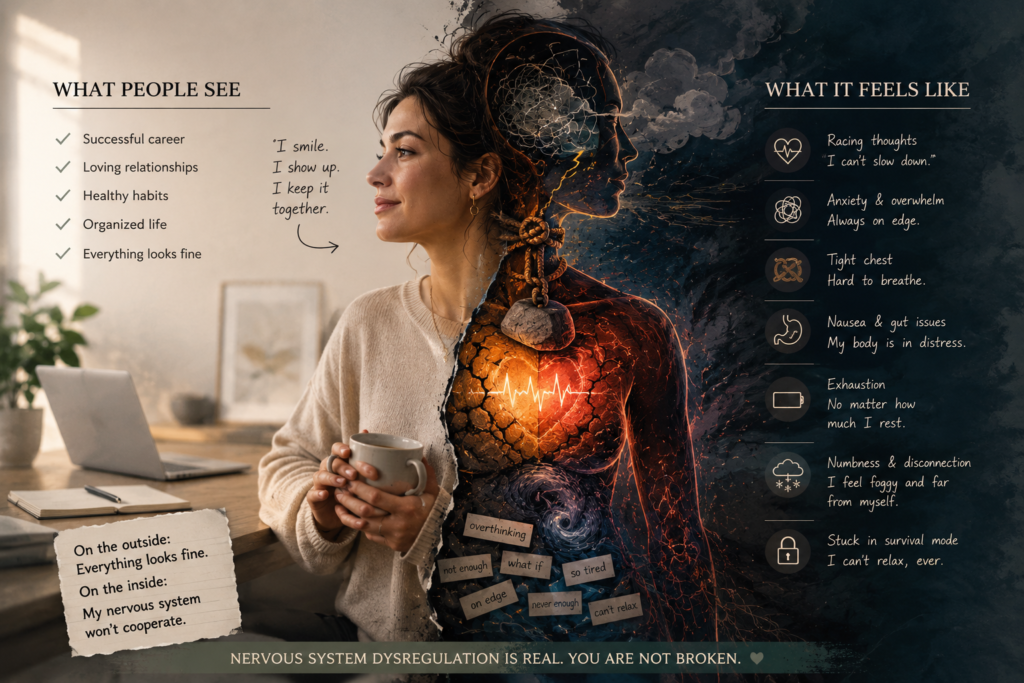
What Nervous System Dysregulation Feels Like
When your body won’t cooperate, even though your life “looks fine.”
You’re doing the same life you’ve been doing for years.
You’re competent. Responsible. High-performing. You meet deadlines. You show up. You keep it together.
But your body is acting like something is wrong.
You feel tired but wired—exhausted, yet unable to truly rest. Your chest holds a low-grade hum of urgency. Your mind keeps scanning for what you forgot, what might go wrong, what you need to fix next. Sometimes you’re irritable and reactive; other times you feel oddly numb, like your emotions are muted and your motivation got turned down. You may wake in the night with a racing mind, or wake in the morning already braced. This “always-on” state maps closely to stress physiology and hyperarousal patterns described in insomnia and stress research, where systems meant to activate temporarily keep running beyond the moment of demand.
When people hear “nervous system dysregulation,” they often picture something dramatic. Panic attacks. A breakdown. Not being able to function.
But one of the most common presentations is quieter:
You do function.
You just don’t feel normal while doing it.
That’s why dysregulation is so easy to miss in high achievers. You’ve learned to override body signals. You’ve learned to perform under pressure. You’ve learned to normalize chronic stress effects—until your system starts pushing back through sleep disruption, cognitive fog, irritability, and physical symptoms that don’t respond to a weekend off.
This article is a clinical-style map of what nervous system dysregulation feels like—and what it actually takes to shift it. It also connects the dots to burnout symptoms, because burnout is not simply “too much work.” The World Health Organization[3] defines burnout in ICD-11 as a syndrome from chronic workplace stress that hasn’t been successfully managed, characterized by exhaustion, cynicism/mental distance, and reduced professional efficacy. [4]
What nervous system dysregulation actually means
“Nervous system dysregulation” is a popular phrase, but it’s not a formal medical diagnosis by itself. It’s a useful functional description: your system’s ability to shift between states (focus → rest, activation → recovery) has become unreliable or stuck.
The core idea: your stress systems are designed to activate and recover
Your body has built-in systems for responding to challenge, then returning to baseline. Two key components are:
- The autonomic nervous system (ANS), which controls automatic functions like heart rate, blood pressure, breathing, sweating, and digestion.
- The stress hormone system, especially the HPA axis (hypothalamic–pituitary–adrenal axis), which coordinates hormonal stress responses, including cortisol.
The ANS includes the sympathetic branch (mobilization; “fight-or-flight”) and the parasympathetic branch (restoration; “rest-and-digest”).
The stress response also has a fast arm (often described as the sympathetic–adreno-medullary system/SAM axis) and a slower arm (HPA axis). [9]
In a regulated system, these networks activate when needed and then settle when the need ends.
In dysregulation, activation becomes easier to trigger, harder to turn off, or swings unpredictably—because the system has been trained by chronic stress, poor recovery, ongoing threat appraisal, or physical contributors (sleep disruption, stimulants, illness, hormones).
Important clarity: dysregulation is not the same as dysautonomia
Many people use “nervous system dysregulation” to explain symptoms like palpitations, dizziness, gut changes, sweating changes, or fatigue. Sometimes, those symptoms are indeed stress-related and state-driven. But sometimes they reflect dysautonomia—a group of disorders that disrupt the autonomic nervous system.
Cleveland Clinic[12] explains dysautonomia as an umbrella term for disorders that disrupt the ANS, with symptoms that may include chest pain, dizziness, fainting, fatigue, and more.
The Mayo Clinic[14] describes autonomic neuropathy symptoms that can include dizziness/fainting when standing (blood pressure drops), urinary problems, sexual difficulties, and digestive issues.
This matters because if your symptoms are severe, progressive, or include frequent fainting/near-fainting, you deserve a proper clinical evaluation—not just stress tips.
What nervous system dysregulation feels like in real life
Most people don’t experience dysregulation as a single symptom. They experience it as a pattern across mind, body, and behaviour.
A useful way to understand the pattern is through the “Window of Tolerance” idea—popular in trauma-informed work to describe the zone where you can think clearly, feel emotions, and respond flexibly. Kids Help Phone[16] explains that people can move above their window (hyperarousal; too much energy) or below it (hypoarousal; too little energy), and that stressors and past difficult experiences can shrink the window.
Hyperarousal: the body in “on” mode
Hyperarousal often feels like your body is running a background emergency program—even when nothing is happening right now.
It may look like:
- Racing thoughts, mental overactivity, trouble “shutting off.”
- A sense of urgency in your chest, restlessness, irritability, snapping more easily.
- Sleep disruption: trouble falling asleep, waking at 3 a.m., waking unrefreshed, or feeling wired at night. Hyperarousal is a central concept in insomnia science, supported by reviews showing arousal processes from molecular to higher-system levels contribute to insomnia pathophysiology. [19]
- Physical stress signals: faster heart rate, tight jaw, muscle tension, shallow breathing, gut disruption. Stress affects multiple systems of the body, including musculoskeletal, respiratory, cardiovascular, endocrine, gastrointestinal, nervous, and reproductive systems.
Cleveland Clinic defines hyperarousal as a prolonged fight-or-flight response that’s too sensitive or stays active too long, with symptoms like hypervigilance, startle response, sensory sensitivity, and angry outbursts.
High-functioning adults often mistake hyperarousal for “motivation.” But biologically, it’s more like your alarm system has a hair trigger.
Hypoarousal: the body in shutdown, fog, or numb mode
Hypoarousal is less talked about because it doesn’t look like anxiety. It looks like low energy, disconnection, or freeze.
Kids Help Phone describes the hypoarousal zone as “not enough energy,” where you may feel disconnected, fatigued, paralyzed, numb, and find it hard to think. [17]
In high performers, hypoarousal often shows up as:
- Emotional flattening: not feeling much, not caring the way you used to. [22]
- Cognitive drag: brain fog, slower processing, decision fatigue. Burnout research reviews describe associations between burnout and cognitive impairment, especially executive functions, attention, and memory. [23]
- Social withdrawal: avoiding people, pulling back, “I don’t have the bandwidth.” [24]
- Increased comfort behaviours: scrolling, zoning out, overeating—not always for pleasure, but for numbness. Chronic stress can influence behaviour and health habits, and sustained stress physiology is associated with broad health impacts. [25]
This is where burnout symptoms often become unmistakable: not just stress, but depletion + distance + reduced sense of effectiveness, consistent with the WHO’s definition. [4]
Oscillation: when you swing between “wired” and “dead”
Many high-functioning adults don’t live in one state. They swing:
- Wired all day → crash at night (but still sleep poorly). [26]
- Motivated in the morning → fog by afternoon → anxious at night. [27]
- Hyper-productive for a week → then collapse → then shame → then push again. [28]
Oscillation is exhausting because it breaks your sense of predictability. You stop trusting your own body. And when you don’t trust your body, you compensate by controlling everything else—time, tasks, food, routines—which often increases activation. [29]
Real-life scenarios that make the “dysregulation” pattern obvious
Scenario: the high performer with the 2 a.m. brain
You fall asleep exhausted. Then you wake and your mind starts solving tomorrow. This is consistent with insomnia models showing cognitive arousal and worry (especially negative, repetitive thinking) can trigger autonomic arousal and maintain sleep disturbance. [30]
Scenario: the “calm” professional who is secretly brittle
You look composed in meetings, but your tolerance is shrinking. Small friction feels huge. Your emotional range narrows. This maps to stress-load concepts like allostatic overload, which can include irritability, sleep disturbance, occupational impairment, and feeling overwhelmed. [31]
Scenario: the productive person who feels numb
You can execute tasks, but you feel disconnected from meaning. This resembles the burnout dimension of mental distance/cynicism and can be part of a protective shutdown response when stress is chronic. [32]
Why dysregulation happens in high-functioning adults
If nervous system dysregulation feels personal, it’s because it’s happening inside you.
But it usually isn’t caused by a single personal flaw.
It’s caused by inputs—chronic stress effects, poor recovery conditions, ongoing cognitive threat evaluation, and sometimes underlying health contributors.
Chronic stress changes the baseline
The American Psychological Association[33] summarizes how stress affects multiple body systems and contributes to physical symptoms and health risks across musculoskeletal, cardiovascular, endocrine, gastrointestinal, nervous, and other systems. [34]
Mayo Clinic similarly explains that long-term activation of the stress response system and prolonged exposure to stress hormones like cortisol can disrupt many body processes, increasing risk of anxiety, depression, digestive issues, headaches, muscle tension, sleep problems, and memory/focus problems. [35]
That list reads like a “nervous system dysregulation” checklist—because chronic stress physiology is one of the most common drivers.
Allostatic load: the wear-and-tear model that explains “why rest doesn’t work anymore”
Allostatic load is strongly associated with the work of Bruce McEwen[36] and colleagues. It describes the cumulative “wear and tear” that results when stress-response systems are activated frequently, don’t shut off efficiently, or become dysregulated over time. [37]
A 2023 clinical review explains allostatic load/overload as strain on the body produced by systems under challenge and describes allostatic overload as potentially showing up as sleep disturbances, irritability, impaired social/occupational functioning, and feeling overwhelmed—without necessarily mapping neatly onto a single diagnosis. [38]
This framework helps high achievers understand a crucial truth:
If your baseline has shifted, a weekend of rest may reduce demand—but it won’t automatically retrain the baseline.
Sleep disruption both reflects and fuels dysregulation
Sleep is not just a casualty of dysregulation. It’s a driver.
Insomnia research strongly supports the hyperarousal model: people with insomnia show increased activation across physiological and cognitive-emotional domains, and this activation can perpetuate sleep problems. [39]
Pre-sleep or nocturnal cognitive arousal (mentally revving, rumination, worry) is associated with objective nocturnal wakefulness, and cognitive models of insomnia describe how worry about sleep and consequences triggers autonomic arousal and selective attention to threat cues. [40]
Some individuals are also more vulnerable to stress-related sleep disruption due to “sleep reactivity,” which has evidence as a trait-level risk factor for insomnia. [41]
So if dysregulation feels worse at night, you’re not imagining it. Sleep and arousal systems are tightly interlinked.
Light and stimulation can quietly train your system to stay activated
Even “normal” evening light exposure can shift biology.
Research has shown that exposure to room light before bedtime suppresses melatonin and delays its onset in most people, shortening melatonin duration. [42]
A controlled study in Proceedings of the National Academy of Sciences[43] found that evening use of light-emitting eReaders before bed delayed circadian timing, suppressed melatonin, and increased time to fall asleep compared with reading a printed book. [44]
This matters for dysregulation because “wired at night” often isn’t purely psychological. It’s also timing, light, stimulation, and learned associations.
Caffeine and alcohol can intensify the “wired” cycle
Caffeine’s mean half-life is about five hours, but it ranges widely (roughly 1.5 to 9.5 hours), which means a “normal afternoon coffee” can meaningfully affect bedtime physiology for some people. [45]
Caffeine promotes wakefulness in part by antagonizing adenosine receptors, reducing sleepiness rather than creating energy. [46]
Alcohol often makes people sleepy initially, but it disrupts sleep architecture, increases awakenings, and reduces REM sleep—contributing to lighter, less restorative sleep and poorer next-day focus. [47]
In dysregulation, these two substances can create a “stimulate by day, sedate by night” loop that keeps the nervous system unstable.
Burnout adds a workplace engine to the physiology
Burnout is not just “feeling stressed.”
The WHO specifies burnout is occupational and reflects chronic workplace stress not successfully managed. [4]
Workplace models like the Job Demands–Resources model describe how job demands are primarily related to the exhaustion component of burnout, while lacking resources relates more to disengagement. [48]
The “areas of worklife” model highlights six domains of mismatch—workload, control, reward, community, fairness, and values—that can drive burnout. [49]
This is why “just regulate your nervous system” sometimes fails. If your environment keeps recreating overload, regulation becomes a constant uphill battle.
A scientifically honest note: the term “burnout” is debated
Some researchers argue burnout’s boundaries are unclear and overlap heavily with depression and other constructs, and that evidence for burnout as a cohesive syndrome is weaker than many assume. [50]
That debate doesn’t invalidate your experience. It simply means the safest clinical approach is to treat your symptoms seriously, assess for depression/anxiety/insomnia and medical contributors when appropriate, and focus on mechanisms (sleep disruption, stress physiology, workplace mismatch, rumination, recovery deficits) rather than debating labels. [51]
How to recover from burnout when your system feels dysregulated
If you’re searching how to recover from burnout and “rest” hasn’t worked, you likely need two kinds of change:
- State change (downshift your physiology in the moment).
- Baseline change (reduce what keeps pushing you out of regulation and rebuild capacity).
Below is a step-by-step, high-functioning-friendly framework. It’s not perfect-life advice. It’s designed for people who still have responsibilities.
Start by identifying your pattern
Before you add tools, name what you’re actually dealing with:
If you’re mostly hyperaroused: racing mind, tight chest, insomnia, irritability, urgency. [52]
If you’re mostly hypoaroused: fog, numbness, collapse, avoidance, “I can’t.” [53]
If you oscillate: wired → crash → wired → crash. [54]
Your tools should match your state. Giving a hypoaroused system more “calming” can deepen shutdown. Giving a hyperaroused system more “activation” can intensify anxiety. [55]
Build a rapid downshift that works in real life
One of the most evidence-supported levers for rapid state change is slow, voluntary breathing.
A 2022 systematic review and meta-analysis found voluntary slow breathing increases vagally mediated heart rate variability (vmHRV) across time points (during breathing, after a session, and after multiple-session interventions), supporting its use as an adjunct for many conditions. [56]
A practical “high performer” protocol: – inhale gently for ~4 seconds
– exhale for ~6 seconds
– repeat for 3–5 minutes
The goal is not instant bliss. It’s reducing physiological intensity enough that your brain stops interpreting the moment as urgent. [57]
Treat sleep as a nervous system intervention, not a lifestyle goal
If your dysregulation includes insomnia, the most evidence-based step is not more sleep hygiene tips—it’s structured insomnia treatment.
The American College of Physicians[58] recommends cognitive behavioural therapy for insomnia (CBT‑I) as the initial treatment for chronic insomnia disorder in adults. [59]
A CBT‑I primer describes key behavioural elements, including stimulus control (e.g., get out of bed if you can’t sleep within ~15–20 minutes; return only when sleepy) and consistent wake time. [60]
Why this matters for nervous system dysregulation: insomnia is closely linked to hyperarousal, and addressing the conditioning and arousal loop reduces one of the strongest reinforcers of daily dysregulation. [61]
Re-anchor your circadian system with light and timing
You don’t need a perfect routine. You need anchors.
Morning light exposure can help shift circadian rhythms earlier (phase advance) in controlled conditions, and mistimed light exposure is well supported to disrupt circadian functioning. [62]
Room light before bedtime suppresses melatonin and delays its onset; evening screen light can delay circadian timing and increase sleep onset latency. [63]
A realistic anchor set: – daylight exposure early in the day
– dimmer light and fewer bright screens in the last hour before bed (even partial reduction helps) [64]
This isn’t about being “healthy.” It’s about removing biological friction that keeps your system alert at the wrong time.
Use movement as a regulation tool, not a punishment
Exercise is not only “fitness.” It’s an arousal regulator for many people.
A 2023 meta-analysis in the British Journal of Sports Medicine[65] concluded physical activity is highly beneficial for improving symptoms of depression, anxiety, and psychological distress across adult populations. [66]
A meta-analysis in older adults also found physical activity interventions produced a medium effect in decreasing anxiety symptom severity compared with controls. [67]
In dysregulation, intensity matters. If you’re already hyperaroused and depleted, very intense training can feel like more sympathetic load. Start with consistent, moderate movement that you can repeat. [25]
Rebuild recovery the way occupational research describes it
High-functioning burnout is often a recovery problem, not a time-off problem.
A 2021 review of interventions to improve recovery from work summarizes a widely used recovery framework: four core recovery experiences are psychological detachment, control during off-job time, relaxation, and mastery experiences. [68]
Psychological detachment has also been linked to better outcomes in meta-analytic work, including improved mood/energy and better sleep quality (the cited paper references this broader evidence base). [69]
Here’s what this looks like for a high performer:
Detachment: one daily boundary that prevents work-thought continuation (e.g., a hard stop, no work apps after X, a shutdown ritual). [70]
Control: one small decision that puts you back in charge of your evening (not your inbox). [68]
Relaxation: low-stimulation time that genuinely downshifts (not doom-scrolling in a stress state). [71]
Mastery: one non-work activity that builds you rather than drains you (brief, chosen, not performative). [68]
This is how you change the baseline: not with one big rest, but with repeated state shifts and recovery experiences.
Address the workplace engine, not just your coping
If your role keeps recreating overload, your nervous system will keep responding like it’s under threat—because it is.
The Job Demands–Resources model and the six areas of worklife model both point to workplace levers (demands, resources, control, fairness, values alignment) as core in burnout dynamics. [72]
Practical workplace moves that actually reduce load: – reduce one recurring demand for 30 days (meeting, deliverable cadence, after-hours availability)
– increase one resource (protected deep-work block, administrative support, clearer priority rules) [72]
This isn’t “soft.” It’s aligning inputs with biology.
When to consider medical assessment
Because “nervous system dysregulation” is an umbrella experience, it’s worth considering medical support if:
- you have frequent fainting/near-fainting, significant dizziness when standing, chest pain, or disabling fatigue (possible dysautonomia/autonomic issues) [11]
- your sleep is chronically impaired with daytime dysfunction (CBT‑I is first-line; evaluation can rule out sleep apnea and other disorders) [73]
- symptoms are escalating into depression, panic, or unsafe coping (burnout overlaps with other conditions and needs appropriate care) [74]
The common mistakes people make when trying to “regulate”
Most people don’t fail because they don’t try. They fail because they target the wrong mechanism.
Mistake: treating a state problem like a mindset problem
If you’re physiologically hyperaroused, positive thinking won’t magically downshift your heart rate, breathing pattern, or sleep fragmentation. Hyperarousal models of insomnia and clinical descriptions of chronic stress make it clear the body can stay activated beyond conscious intent. [75]
Mindset can help—once your state is stabilizing. But state usually comes first.
Mistake: stacking “productive wellness” on top of depletion
High performers often turn recovery into another performance arena: intense workouts, rigid routines, endless tracking.
In burnout and allostatic overload patterns, more load can worsen wear-and-tear. Allostatic overload frameworks explicitly describe persistent strain as a transdiagnostic load state that can present with sleep problems, irritability, and impaired functioning. [38]
Mistake: using stimulants and sedatives to force the cycle
Caffeine can linger for hours with wide variability in clearance, and alcohol disrupts sleep architecture and increases awakenings. If you wake tired and wired, that cycle often intensifies dysregulation rather than resolving it. [76]
Mistake: resting without detaching
If your body is on the couch but your brain is still at work, you haven’t stepped out of the stressor. Recovery research repeatedly identifies psychological detachment as a core recovery experience. [70]
A deeper solution when you’re done collecting tips
If you’re living with nervous system dysregulation, you don’t just need more tools.
You need a structure that changes the pattern that keeps recreating dysregulation—physiologically and behaviourally—especially if burnout symptoms are present.
That’s the domain of structured programs built for high performers.
On the OOverall Health[77] site, The Calm Rebuild™[78] is presented as a 12-week, “clinical-grade” transformation designed for high-capacity leaders who “cannot afford to crash,” with a staged roadmap focused on nervous system calibration, identity shift, cognitive capacity expansion, and high-stakes resilience. [79]
The program page also describes weekly live clinical sessions, evidence-based protocols, a personalized recovery plan, implementation support, and a resource vault, framed specifically around restoring baseline regulation and cognitive clarity rather than generic stress management. [79]
If your pattern is:
rest → temporary relief → return to the same demands → immediate relapse,
then “more rest” is not the missing piece. A deeper rebuild is. [80]
A strong but calm conclusion
Nervous system dysregulation is not a personality flaw.
It’s what it feels like when systems designed for short-term activation are asked to run like that long-term—until your baseline shifts.
It can feel like hyperarousal (wired, anxious, restless), hypoarousal (foggy, numb, shut down), or exhausting oscillation between the two. [81]
If you’re also experiencing burnout symptoms, remember the WHO definition: burnout is a chronic occupational stress syndrome marked by exhaustion, mental distance/cynicism, and reduced professional efficacy. [4]
Recovery is possible—but it’s rarely a single weekend, a single supplement, or a single mindset shift. The evidence points toward mechanisms: stabilizing sleep, reducing chronic stress inputs, building real recovery experiences (especially detachment), and retraining physiological flexibility through tools like slow breathing and appropriate movement. [82]
When you stop trying to “outperform” your nervous system—and start rebuilding the conditions it needs to return to baseline—the entire experience begins to change. [54]