
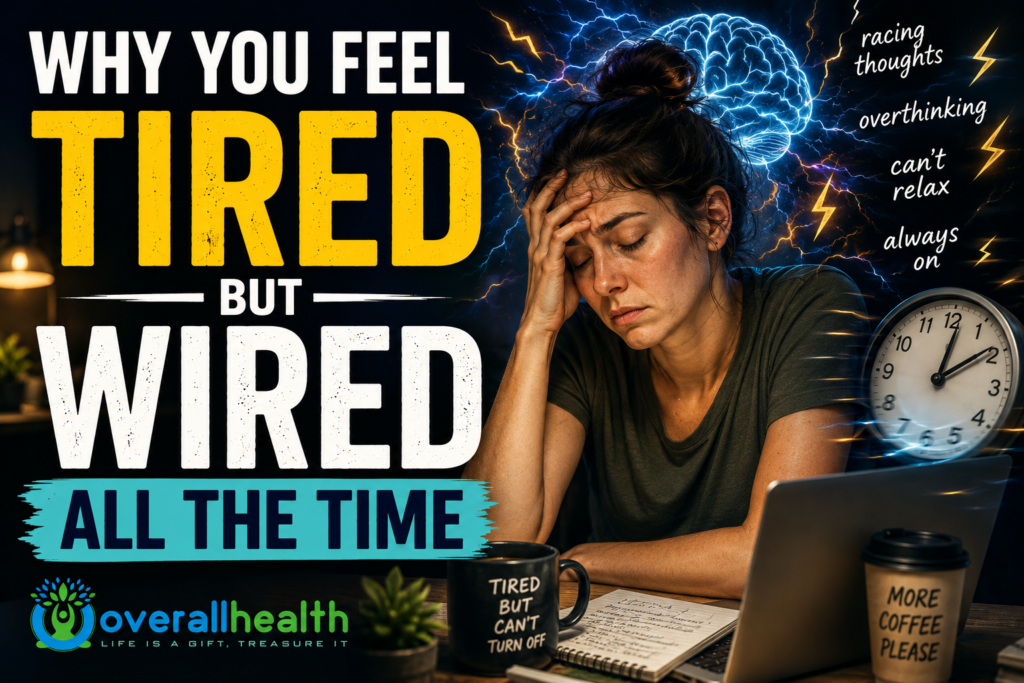
Why You Feel Tired But Wired All the Time.
The tired-but-wired paradox
You’re exhausted, but you can’t truly rest.
By late afternoon, your body feels heavy. Your focus is thin. You yawn, you crave sugar or caffeine, you promise yourself you’ll go to bed early.
Then night comes… and something flips.
Your mind starts sprinting. Your heart feels slightly “on.” Your thoughts loop: tomorrow’s deadlines, that conversation, the money thing, the health thing, the one more task you didn’t finish. Even if you fall asleep, you wake up too early with a buzzy, anxious alertness—like your system never fully powered down.
This isn’t you being dramatic. This pattern is common in chronic stress, anxiety, and burnout states—and it often signals nervous system dysregulation, where your stress-response systems have become over-trained and under-recovered. [1]
It also explains why “just relax” advice feels insulting: the problem isn’t a lack of effort. It’s that your body is treating rest as unsafe.
And that “tired but wired” state often comes packaged with other burnout symptoms: emotional flatness, irritability, low motivation, brain fog, reduced performance, and that disturbing feeling that even your free time doesn’t refill you. [2] [3]
What’s actually happening in your body
“Tired but wired” is not a character flaw. It’s physiology.
There are three big systems to understand:
Sleep pressure (homeostatic drive): The longer you’re awake, the more your sleep pressure builds (partly through chemicals like adenosine). This is your body’s basic “need to sleep” signal. [3]
Your circadian rhythm (body clock): Your internal clock coordinates alertness and sleepiness across a 24-hour cycle. Light exposure is a major driver—especially morning light and evening darkness. [4]
Your stress response (HPA axis + autonomic nervous system): Stress activates the hypothalamic–pituitary–adrenal axis and the autonomic nervous system, helping you mobilize energy and stay alert when there’s danger or demand. Chronic activation can keep your system “upshifted,” even when you’re trying to sleep. [5] [6]
When you feel tired but wired, it often means:
- Your sleep pressure is high (you’re genuinely fatigued).
- But your circadian timing and/or alerting signals are misaligned (your body clock is not fully cooperating).
- And your stress system is still sending “stay awake” signals (hyperarousal). [7] [4]
This “hyperarousal” state is a well-established part of insomnia science. People can show heightened cognitive and physiological activation—especially at bedtime—where the brain keeps scanning, solving, and bracing instead of downshifting.
And here’s the part most high-functioning adults miss:
You can be dead tired and still have a nervous system that refuses to let you “drop.” That’s not contradictory. It’s what happens when the body learns that being “on” is safer than being still. [8]
The chronic stress effects that keep you activated
Chronic stress doesn’t only affect mood. It affects the whole body over time—sleep, digestion, cardiovascular tone, immune activity, and brain function. [9]
A helpful scientific frame here is allostatic load—the “wear and tear” that builds when stress systems are activated too often or don’t shut off efficiently. This isn’t just poetic language; it’s a researched model describing cumulative stress burden and dysregulation across multiple biological systems. [10]
In plain terms:
If your life requires you to run “high alert” all day, your body can start treating high alert as your baseline.
“Is this adrenal fatigue?”
A lot of people search that phrase because it matches the experience: exhaustion, cravings, brain fog, poor sleep.
But “adrenal fatigue” is not a recognized medical diagnosis, and major endocrine organizations state there’s no scientific proof it exists as a distinct condition. [11]
That doesn’t mean you’re fine. It means the better question is:
What’s driving your fatigue and your hyperarousal?
Because there are real, evidence-based explanations—and real, evidence-based ways out. [12]
Why it happens: the main drivers
Most “tired but wired” cases aren’t caused by one thing. They’re caused by a stack.
If you’re a high-functioning adult, that stack often includes performance pressure, constant decision-making, “always reachable” work culture, and ongoing emotional load—plus a few sleep-disrupting inputs you may be underestimating.
The hyperarousal loop
Insomnia models describe how worry about sleep, rumination, and compensatory behaviours can create a self-reinforcing loop: you don’t sleep well → you worry and try harder → your system activates more → sleep gets worse. [13]
A particularly important trait factor is sleep reactivity—how strongly your sleep gets disrupted by stress. Some people are simply more stress-sensitive sleepers, and that vulnerability becomes very visible during burnout seasons. [14]
Circadian disruption that looks like “anxiety at night”
If your days are indoors, screen-heavy, and you get minimal morning light—while your evenings are bright and stimulating—your light exposure pattern can push your sleep timing later and reduce natural sleepiness at bedtime. [15]
Evening blue light is especially potent in suppressing melatonin and shifting circadian rhythms in controlled studies. [16]
Morning light, in contrast, can help anchor your clock earlier. Reviews of morning light interventions suggest phase advances can occur when light is delivered shortly after waking. [17]
Caffeine: not “bad,” but often mistimed
Caffeine doesn’t just give energy. It blocks sleepiness signals (adenosine-related sleep pressure) and can worsen the wired feeling—especially if you’re already running on stress chemistry. [18]
Caffeine’s average half-life is about five hours, with wide individual variation (some people clear it much more slowly). So a “2 p.m. coffee” can still meaningfully affect bedtime physiology for many people. [19]
And yes—up to 400 mg/day is often cited as a general safe limit for most adults, but “safe” doesn’t mean “sleep-neutral,” especially in burnout. [20]
Alcohol: the false off-switch
Alcohol can make you feel sleepy initially, but it tends to worsen sleep quality and continuity later in the night, including more wake-ups and REM disruption—especially with heavier or repeated use. [21]
So the pattern becomes: you drink to downshift → you sleep poorly → you wake wired → you lean harder on caffeine → you need more to “come down.” That’s not a moral issue. It’s a predictable loop. [22]
Anxiety and burnout overlap
Sleep problems commonly co-occur with anxiety disorders and other mental health conditions. [23]
Meanwhile, burnout is recognized by the World Health Organization[24] as an occupational phenomenon characterized by exhaustion, mental distance/cynicism, and reduced professional efficacy. [25]
Burnout research also notes overlap with depressive symptoms and stress-related physiology, which matters because fatigue plus insomnia can sit at the intersection of mood, stress load, and sleep regulation. [26]
Real-life scenarios that fit the “tired but wired” pattern
Scenario: The high-achieving problem solver
You’re competent, dependable, and the person everyone turns to. Your day is nonstop micro-decisions and emotional containment. At night, your brain finally has silence—so it starts processing everything you postponed. You’re not “overthinking.” You’re experiencing delayed processing plus conditioned arousal at bedtime, which insomnia models explicitly describe. [27]
Scenario: The nervous system that can’t “shift gears”
You end work and go straight into family logistics, screens, news, messages, and one last email. There’s no transition. Your body never receives a clear signal that the day ended and safety began. Light exposure and cognitive stimulation stay high; melatonin and wind-down cues stay low. [15]
Scenario: The burnout recovery that backfires
You try to “fix it” by sleeping in, napping, and cancelling movement. But inconsistent wake times and long naps can reduce sleep pressure and further destabilize circadian rhythm—so bedtime becomes even more awake. This is why insomnia treatment is often counterintuitive and structured. [28]
How to recover from burnout when you feel tired but wired
If your system is “tired but wired,” you don’t need more willpower.
You need a recovery strategy that treats this like what it is: a stress-and-sleep regulation problem—not a motivation problem.
The most effective approaches combine: – nervous system downshifting (reducing hyperarousal), – circadian anchoring (timing + light), – and sleep-behaviour retraining (so your bed becomes a cue for sleep again). [29]
Below is a practical structure I use with high-functioning adults. It’s not fluffy. It’s doable.
Stabilize first, optimize later
When you’re burnt out, your first goal is stability, not perfection.
Anchor one thing: your wake time (within a consistent window most days). This supports circadian rhythm and makes your sleep drive more predictable. [30]
Then build the rest around that anchor.
A grounded, step-by-step reset
Daily step: morning light within the first hour
Get outside light shortly after waking, even if it’s cloudy. Morning light helps reinforce circadian timing, which supports earlier sleepiness later. [31]
Daily step: a caffeine boundary that matches your biology
Instead of asking “Should I quit caffeine?” ask: “What time is my last caffeine that still protects my sleep?”
Given caffeine’s half-life and individual variability, many people do better with a cutoff 8–10 hours before bedtime, especially in anxiety/burnout seasons. [32]
Evening step: reduce bright light and screens
Light affects melatonin and circadian timing. If you’re on bright screens close to bedtime, you may be training your brain to stay in “day mode.” [15]
You don’t need a perfect digital detox. Start with one solid move: dim the environment and lower screen brightness in the last hour.
Evening step: a “brain dump” that ends rumination
Rumination and “sleep effort” are core perpetuators in the hyperarousal model. [27]
Try this: 10 minutes, written. Two columns: – “Not done / not decided” – “Next smallest step (tomorrow)”
Then stop. The point is not to solve your life at night; it’s to signal containment.
Nervous system step: slow breathing as a state shift
Voluntary slow breathing has been repeatedly studied for effects on autonomic regulation, including increases in measures of vagally-mediated heart rate variability during and across interventions. [33]
A simple protocol: – inhale 4–5 seconds – exhale 5–6 seconds – continue for 5 minutes
You are not trying to “relax” by force. You’re giving your body a rhythm cue that supports downshifting.
Weekly step: reduce allostatic load, not just symptoms
If your schedule keeps recreating the same stress physiology, the best sleep routine in the world will struggle. Chronic stress biology is cumulative. [34]
So pick one load-reducer you can repeat: – one protected lunch per week without screens, – one meeting you decline, – one evening with a hard stop time, – one task you deliberately do at 80% instead of 110%.
In burnout recovery, capacity comes back when your body trusts that demand has limits.
Use evidence-based sleep treatment when insomnia is established
If you’ve had ongoing difficulty falling asleep, staying asleep, or waking too early—with daytime impairment—evidence-based insomnia treatment matters.
Multiple clinical guidelines recommend cognitive behavioural therapy for insomnia (CBT‑I) as a first-line treatment for chronic insomnia. [35]
CBT‑I is not “sleep hygiene.” It commonly includes structured components like stimulus control, sleep consolidation, and cognitive strategies that reduce sleep-related arousal. [36]
That’s important, because many tired-but-wired adults keep adding tips… without changing the mechanisms that perpetuate insomnia.
What about mindfulness?
Mindfulness-based approaches are not magic, and results vary by population and study design. Some reviews show mixed findings for sleep outcomes in certain groups. [37]
But mindfulness-based interventions have strong evidence for anxiety reduction, including rigorous trials where mindfulness-based stress reduction was comparable to a first-line medication for anxiety disorders. [38]
For tired-but-wired people, that matters because lowering cognitive arousal and threat scanning often improves the conditions for sleep—even when sleep itself doesn’t instantly normalize.
The mistakes that keep you stuck
Most people aren’t failing because they don’t care. They’re failing because they’re applying the wrong strategy to the wrong problem.
Mistake: treating fatigue with stimulants, then treating stimulation with sedatives
Caffeine late in the day can prolong alertness because of its long and variable half-life. [19]
Alcohol can initially sedate but worsen sleep quality and lead to more awakenings later. [39]
That combination can lock you into a nervous system “yo-yo.”
Mistake: chasing a supplement diagnosis instead of a real assessment
If you’re told you have “adrenal fatigue,” it can distract you from finding the real drivers—sleep disorder, depression, anxiety disorder, iron deficiency, thyroid issues, medication effects, sleep apnea, perimenopause-related sleep changes, or chronic insomnia that needs CBT‑I. Major endocrine sources explicitly warn that adrenal fatigue lacks scientific proof as a condition. [40]
Mistake: trying to “fix sleep” only at night
Tired-but-wired insomnia isn’t just a nighttime problem. It’s a 24-hour regulation issue involving stress-system activation, circadian cues, and learned associations with bed/wakefulness. [41]
If your day is wall-to-wall demand and your nights are the only time you stop, your brain will keep using nighttime as processing time.
Mistake: inconsistent wake times and long naps
When you sleep in late or nap long, you reduce sleep pressure and can shift your schedule later, amplifying the “awake at night” pattern. Sleep science describes sleep pressure as something that builds with time awake and releases during sleep—so timing matters. [42]
Mistake: over-focusing on metrics when you’re already anxious
Tracking can help—until it becomes another performance arena. Hyperarousal models highlight how sleep effort and rumination maintain insomnia. [43]
If your wearable data makes you spiral, scale it back. You’re trying to restore safety, not win sleep.
When to get medical support
Sometimes, tired-but-wired is primarily nervous system overload. Sometimes it’s a sleep disorder or medical factor that requires direct care.
If any of the following are true, it’s worth speaking with a qualified clinician:
You snore loudly, gasp, choke, or someone notices breathing pauses
Obstructive sleep apnea can cause fragmented sleep and daytime exhaustion, and it can coexist with insomnia symptoms. [44]
You have severe daytime sleepiness or a safety risk
If you’re dozing while driving, working, or sitting quietly, take it seriously. Sleep disorders can have major health and safety consequences. [45]
Your insomnia has become chronic
Chronic insomnia is common and treatable. CBT‑I is recommended as first-line treatment by major guideline groups. [35]
Your anxiety or mood symptoms are escalating
Sleep problems frequently co-occur with anxiety and other mental health conditions, and bidirectional worsening is common. [46]
This is not about pathologizing you. It’s about not missing the obvious.
A deeper reset: rebuilding your capacity
Here’s the uncomfortable truth that high-functioning adults often need to hear:
If you’re living in a way that constantly triggers stress physiology, your body will keep producing stress hormones.
You can’t “biohack” your way out of a life that your nervous system experiences as relentless.
This is why burnout recovery must go deeper than tips. It has to rebuild capacity.
Capacity is your ability to: – complete stress cycles and return to baseline, – tolerate stillness without threat, – focus without clenching, – and rest without your brain interpreting rest as “lost time.” [47]
That rebuilding typically requires three layers working together:
Physiology: downshift the stress response (breathing, movement, light timing, sleep retraining). [48]
Psychology: reduce threat appraisal, rumination, and sleep-related fear/effort. [43]
Lifestyle structure: reduce allostatic load by changing the inputs that keep your system dysregulated. [49]
This is exactly why I built The Calm Rebuild™: a structured path for high-achieving, burned-out adults who are tired of collecting advice and ready to change the system underneath the symptoms.
It’s designed for the person who says:
“I can push through anything… except my own nervous system.”
In The Calm Rebuild™, the goal isn’t to become someone who never feels stress. The goal is to become someone whose body can feel stress—and still return to calm without needing collapse, scrolling, wine, or weekend hibernation to survive.
If you’ve been stuck in tired-but-wired for months (or years), a deeper container matters. Not because you’re broken. Because your stress response has been trained—and training changes with structure.
Conclusion
Feeling tired but wired is one of the clearest signals you can get that your system is overworked and under-recovered.
It’s not imaginary. It’s not weakness. It’s not a sign you need to “try harder.”
It’s a sign your body has learned to stay alert—long after the danger is gone—because your life has been running like danger is always near.
The way forward is not more intensity. It’s smarter regulation.
Anchor your circadian rhythm. Protect your sleep pressure. Reduce the inputs that keep your stress system activated. Use evidence-based tools like CBT‑I when insomnia is entrenched. Build micro-recoveries that lower allostatic load instead of only treating symptoms. [50]
And most importantly: stop interpreting your nervous system as an enemy.
It’s trying to protect you.
Your job now is to teach it that it can stand down.
References
[1] [12] Feeling tired but wired? Here’s what might be causing it
[2] [25] Burn-out an “occupational phenomenon”: International …
[3] [28] [42] Module 2. Sleep Pressure: Homeostatic Sleep Drive | NIOSH
[4] Circadian Rhythm: What It Is, How It Works & What Affects It
https://my.clevelandclinic.org/health/articles/circadian-rhythm?utm_source=chatgpt.com
[5] HPA Axis and Sleep – Endotext – NCBI Bookshelf – NIH
https://www.ncbi.nlm.nih.gov/books/NBK279071/?utm_source=chatgpt.com
[6] [24] Sleep Drive and Your Body Clock
[7] [13] [27] [41] Clinical review The hyperarousal model of insomnia
https://www.sciencedirect.com/science/article/abs/pii/S1087079209000410?utm_source=chatgpt.com
[8] Hyperarousal: What It Is, Causes, Symptoms & Treatment
https://my.clevelandclinic.org/health/symptoms/hyperarousal?utm_source=chatgpt.com
[9] Stress effects on the body
https://www.apa.org/topics/stress/body?utm_source=chatgpt.com
[10] [34] [47] [49] Stress, adaptation, and disease. Allostasis and allostatic load
https://pubmed.ncbi.nlm.nih.gov/9629234/?utm_source=chatgpt.com
[14] [43] Hyperarousal and sleep reactivity in insomnia: current insights
https://pmc.ncbi.nlm.nih.gov/articles/PMC6054324/?utm_source=chatgpt.com
[15] Light & Sleep: Effects on Sleep Quality
https://www.sleepfoundation.org/bedroom-environment/light-and-sleep?utm_source=chatgpt.com
[16] Blue light has a dark side
[17] Can Morning Light Phase Advance Human Melatonin … – PMC
https://pmc.ncbi.nlm.nih.gov/articles/PMC12989132/?utm_source=chatgpt.com
[18] Adenosine and Sleep: Understanding Your Sleep Drive
https://www.sleepfoundation.org/how-sleep-works/adenosine-and-sleep?utm_source=chatgpt.com
[19] [32] Pharmacology of Caffeine – NCBI – NIH
https://www.ncbi.nlm.nih.gov/books/NBK223808/?utm_source=chatgpt.com
[20] Caffeine: How much is too much?
[21] [22] [39] Alcohol and Sleep
https://www.sleepfoundation.org/nutrition/alcohol-and-sleep?utm_source=chatgpt.com
[23] What are Sleep Disorders?
[26] Burnout phenomenon: neurophysiological factors, clinical …
https://pmc.ncbi.nlm.nih.gov/articles/PMC9478693/?utm_source=chatgpt.com
[29] [36] Behavioral and psychological treatments for chronic insomnia …
https://pmc.ncbi.nlm.nih.gov/articles/PMC7853203/?utm_source=chatgpt.com
[30] [31] [50] How to Fix Your Circadian Rhythm: 6 Easy Steps
[33] [48] Effects of voluntary slow breathing on heart rate and …
https://pubmed.ncbi.nlm.nih.gov/35623448/?utm_source=chatgpt.com
[35] Management of Chronic Insomnia Disorder in Adults
https://pubmed.ncbi.nlm.nih.gov/27136449/?utm_source=chatgpt.com
[37] Effects of mindfulness-based stress reduction on adults with …
https://pmc.ncbi.nlm.nih.gov/articles/PMC9639069/?utm_source=chatgpt.com
[38] Mindfulness-Based Stress Reduction vs Escitalopram for …
https://jamanetwork.com/journals/jamapsychiatry/fullarticle/2798510?utm_source=chatgpt.com
[44] [45] Sleep apnea – Symptoms and causes
[46] Insomnia, anxiety and related disorders: a systematic review …
https://pmc.ncbi.nlm.nih.gov/articles/PMC12244189/?utm_source=chatgpt.com